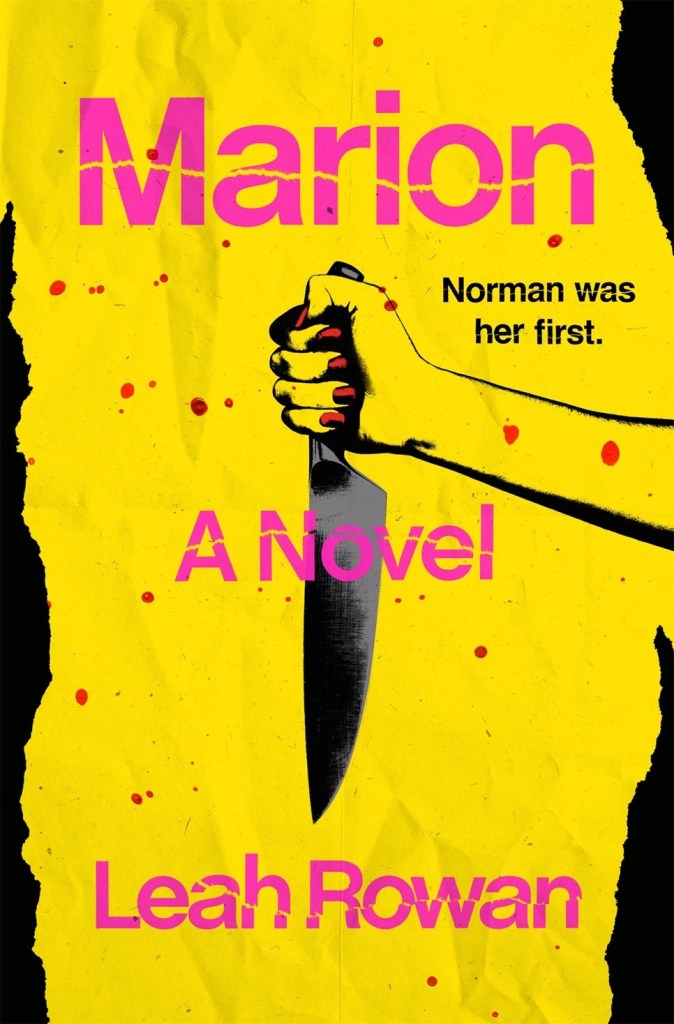
Release date: June 2, 2026
Publisher: St. Martin’s Press
Genre: Mystery/Thriler
Synopsis:
A twist on Hitchcock’s iconic classic Psycho —where the leading lady doesn’t die, but instead turns the knife on Norm, kicking off a crime spree that turns the silver screen victim into a heroine for our times.
NORMAN WAS HER FIRST.
Marion is in deep. She’s stolen money from the Manhattan ad agency where she works in a desperate bid to help her sister escape an abusive marriage, but the bus breaks down before she can make it to Saratoga Springs. It’s late at night, and the only place with vacancies is an old set of cabins on the outskirts of town. She pays for a room in cash, and ends up chatting with Norm, the young innkeeper who’s handsome, charming and a touch hung-up on his elderly mother. Back in her room, she steps into the shower, scrubbing off the late-summer heat, when the curtain is pulled back…
Norm Billings is there with a knife. He raises his arm to strike, but before he does, Marion knees him in the balls, grabs the knife, and stabs the life out of him. Now, she’s covered in blood, and she’s a woman on the run—not just a thief, but a killer, too. Where will she go? How will she save both herself and her sister? And what mysteries will she uncover as she does?
In Psycho, Hitchcock shocked audiences when he killed off his protagonist. But what if the leading lady had fought back? Marion offers an alternate history of the most famous dead blonde to ever grace the silver screen. Only this time, the knife is in her hands—and she’s no victim.
Review:
Leah Rowan’s Marion is a bold, razor sharp reimagining of Hitchcock’s Psycho that flips the narrative of victimhood on its head. Taking inspiration from one of cinema’s most iconic horror stories, Rowan asks a simple but explosive question: what if Marion didn’t die in that motel shower? The result is a tense, twisty thriller that leans darker and more emotionally complex than the author’s previous popcorn thriller work under her other pen name. That shift is noticeable in the best way—this feels more grounded in psychological weight, more interested in what survival does to a woman’s mind than just the mechanics of suspense.
At its core, this is a story about fear, rage, and the quiet endurance of women who have learned to live with both. Marion’s journey begins in desperation, stealing money to help her sister escape an abusive marriage, before spiraling into something far more chaotic and irreversible. The moment at the motel is both shocking and cathartic, but what follows is where the book really earns its ambition: a woman on the run not just from the law, but from the identity of “victim” itself. Rowan threads in sisterhood, mother daughter trauma, shame, and survival instincts in a way that gives Marion’s choices emotional weight, even when they’re morally complicated. It’s very much a “final girl” story, except it keeps asking what happens after the credits roll and the girl is still alive.
That said, the pacing does wobble in the middle. After a gripping and propulsive opening, the narrative briefly loses some momentum as Marion’s journey becomes more internal and fragmented. It’s not enough to derail the book, but it does slightly dilute the urgency that makes the first act so addictive. Fortunately, it recovers in the final stretch, pulling the threads back together for a satisfying, tense conclusion that re-centers the thriller elements and emotional stakes. By the end, Marion lands as both a feminist reworking of a classic and a character study about what it means to survive violence, and what survival can turn you into.
Overall rating: 4/5
Thanks to the publisher for my review copy.

